- Category
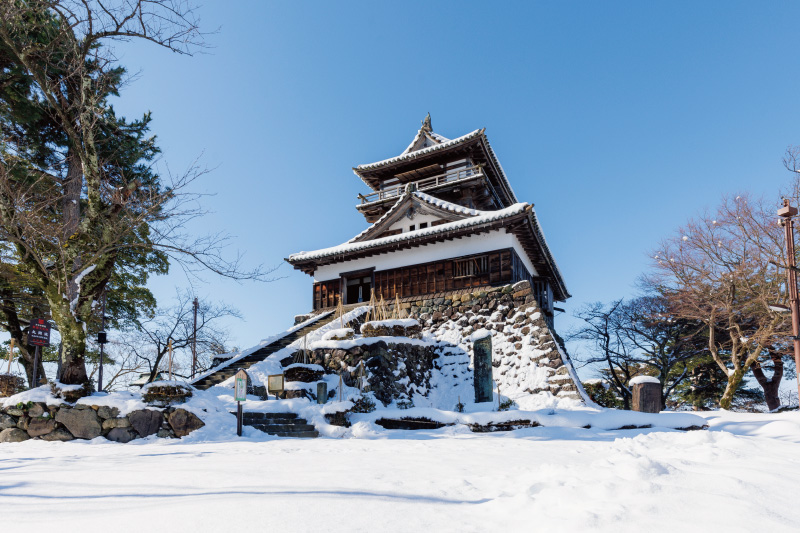
- Original keep (rebuilt 1955 with original materials), Important Cultural Property
- Location
- Sakai, Fukui Prefecture
- Nearest station
- Maruoka Castle bus stop, by bus from Fukui or Awara-Onsen Station
- From the city
- About 20 min by bus or taxi from Awara-Onsen Station
- Hours & admission
- Latest information
Overview
Maruoka Castle is a small wooden castle on a low hill in Sakai, Fukui Prefecture, on the Sea of Japan side of central Japan. It is one of the 12 castles with an original keep, and it is claimed to be the oldest in Japan, a claim shared with Inuyama and Matsumoto. Its main features are the roof, which is covered in heavy stone tiles instead of clay, and its setting in a park with about 400 cherry trees. It is also called Kasumigajo, or Mist Castle, from a legend that mist hid it from enemies.
History
Shibata Katsutoyo, a nephew of the general Shibata Katsuie, built the castle in 1576 on orders from Oda Nobunaga. During the Edo period, a succession of lords ruled from the castle, and the Arima family held it until 1871. The castle was mostly dismantled after that, but the keep was kept and the site became a park in 1901.
The keep was destroyed in the 1948 Fukui earthquake, and it was rebuilt in 1955, reusing most of its original materials, so it keeps its old appearance and structure.
A well-known legend says that a woman named Oshizu was sacrificed as a human pillar when the stone base of the keep kept collapsing during construction. Whether or not the story is true, it is part of the castle's character.
What to See
The keep has two stories outside and three floors inside. The roof of gray stone tiles is very unusual in Japan and is designed to survive the heavy snow of the region. Inside, the wooden floors and steep stairs are original in style, and ropes are provided as handrails to help you climb. The top floor has a view over the plain and the surrounding mountains.
At the foot of the hill, a small museum shows objects related to the lords of Maruoka. The park, Kasumigajo Park, has about 400 Yoshino cherry trees, and the Cherry Blossom Festival in April is the main event of the year.
Getting There
From Awara-Onsen Station, the Shinkansen station nearest to the castle, a bus or taxi takes about 20 minutes. From JR Fukui Station, a Keifuku bus goes to the castle stop in about 30 to 50 minutes. The castle is about a minute's walk from the bus stop.
From Tokyo, the Hokuriku Shinkansen reaches Fukui and Awara-Onsen in roughly three hours.
Where to Eat Nearby
Fukui is known for seafood and soba. Look for:
- Echizen soba: buckwheat noodles served with grated daikon radish.
- Echizen crab: a winter delicacy of the Fukui coast.
- Fukui-style sauce katsudon: pork cutlet on rice with a sweet-savory sauce.
Restaurants open and close often, so use the map links at the bottom of this page to see what is open near the castle today.
Plan Your Visit
Allow about one hour for the keep, the museum and the park. The stairs are steep, and you take off your shoes to go inside. The best time is early April, when the cherry trees bloom, and you can also visit in autumn during the Maruoka Castle Festival in October.
Opening hours and admission change, so check the information page.
Staying in the Area
Awara Onsen, a hot spring town near the Shinkansen station, is a popular place to stay. Fukui city is another option, with more hotels.
FAQ
Is the keep original?
Yes, but it was rebuilt in 1955 after the 1948 earthquake, using most of the original materials.
Is it really the oldest?
It claims to be, and its date of 1576 is early, but Inuyama and Matsumoto also claim to be the oldest.
Why is the roof made of stone?
Stone tiles are heavy and resist the harsh winters of the area.