- Category
- Palace-castle, UNESCO World Heritage Site
- Location
- Nakagyo Ward, Kyoto
- Nearest station
- Nijojo-mae Station (Tozai Subway Line)
- From the city
- About 15-20 min from Kyoto Station by bus or subway
- Hours & admission
- Latest information
Overview
Nijo Castle is not a tower castle. It is the Kyoto residence of the Tokugawa shoguns, a palace of tatami halls and gold-leaf paintings surrounded by moats, stone walls and gardens. It is a UNESCO World Heritage Site as part of the Historic Monuments of Ancient Kyoto, and its Ninomaru Palace is a National Treasure. If you want to see the inside of a shogun's residence and walk floors that squeak like birds, this is the place.
History
Tokugawa Ieyasu, the first shogun of the Edo period, built Nijo Castle in 1603 as his residence in Kyoto. His grandson Iemitsu expanded it in the 1620s for a visit by the emperor, in 1626, giving it the layout you see today.
In 1867, the last shogun, Tokugawa Yoshinobu, announced in the Ninomaru Palace that he was returning political power to the emperor. That decision ended more than 250 years of Tokugawa rule. After that, the castle served as an imperial palace before being given to the city of Kyoto and opened to the public.
What to See
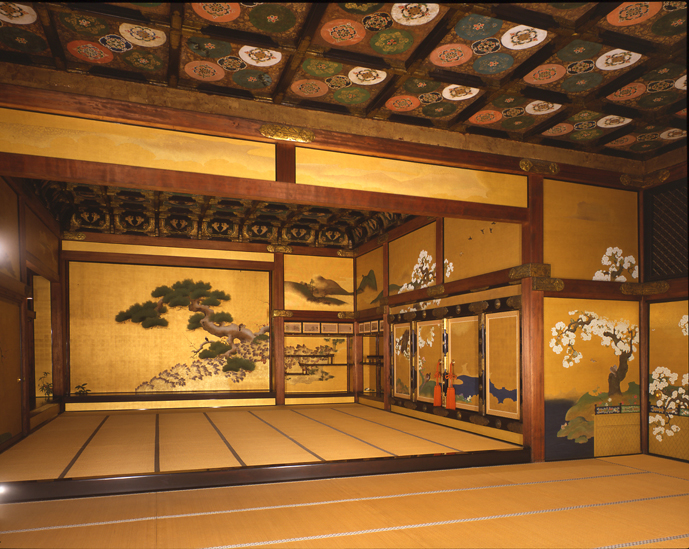
The Ninomaru Palace is the main attraction. Its six connected buildings are decorated with painted sliding doors, carved transoms and gold leaf, and the rooms are arranged to show the rank of each visitor, with the most elaborate in the shogun's own space. The corridors have "nightingale floors" (uguisubari) that chirp when you walk on them, built as a warning against intruders. Photography is not allowed inside the palaces.
Before the palace, you pass through the Karamon Gate, a richly carved gate that shows the power of the Tokugawa family. The Ninomaru Garden beside the palace has a large pond and carefully placed stones.
The Honmaru Palace in the inner circle was reopened to the public in 2024 after a long restoration. Entering it requires an advance reservation and a separate fee. In the inner circle, the stone base of a former five-story keep, lost to fire in the 18th century, can be climbed for a view over the grounds.
Getting There
The castle is next to Nijojo-mae Station on the Kyoto Subway Tozai Line, so you can walk to the entrance in a couple of minutes. From Kyoto Station, buses and the subway (with a change) take about 15 to 20 minutes. JR Nijo Station is also within walking distance, about 15 minutes.
Where to Eat Nearby
The streets right around Nijo Castle are quieter than downtown Kyoto, so many visitors eat before or after in the central districts, a short bus or subway ride away. Kyoto specialties to look for:
- Yudofu: tofu simmered in hot water and eaten with dipping sauces.
- Obanzai: small dishes of home-style Kyoto cooking.
- Matcha sweets: desserts and drinks made with Kyoto green tea.
- Kaiseki: a multi-course meal that is Kyoto's traditional fine dining.
Restaurants open and close often, so use the map links at the bottom of this page to see what is open near the castle today.
Plan Your Visit
Allow about two hours for the Ninomaru Palace, the gardens and the grounds. Arriving when the castle opens avoids the tour groups. The Ninomaru Palace and Honmaru Palace are closed on certain days, including some Tuesdays and the New Year period, and the Honmaru Palace needs a reserved ticket, so check the official calendar before you go.
Cherry blossom season lasts a long time here because of the many varieties of trees, usually from late March through April. The plum blossoms bloom earlier, in late February and early March. Audio guides in English can be rented near the entrance.
Next door, Shinsen-en is a small garden with a pond that dates from the Heian period and is quiet compared with the castle.
Staying in the Area
Nijo is on the west side of central Kyoto. Staying near Karasuma-Oike, Kawaramachi or Kyoto Station gives easy access to the Tozai Line and to buses that reach the castle.
FAQ
Is there a keep at Nijo Castle?
No. The five-story keep that once stood here burned down in the 18th century. The attractions are the palaces, gates, gardens and walls.
Can I take photos inside?
Not inside the Ninomaru or Honmaru Palaces. Outside, in the gardens and at the gates, photography is allowed.
How long does the visit take?
Plan about two hours, or longer if you reserve the Honmaru Palace.