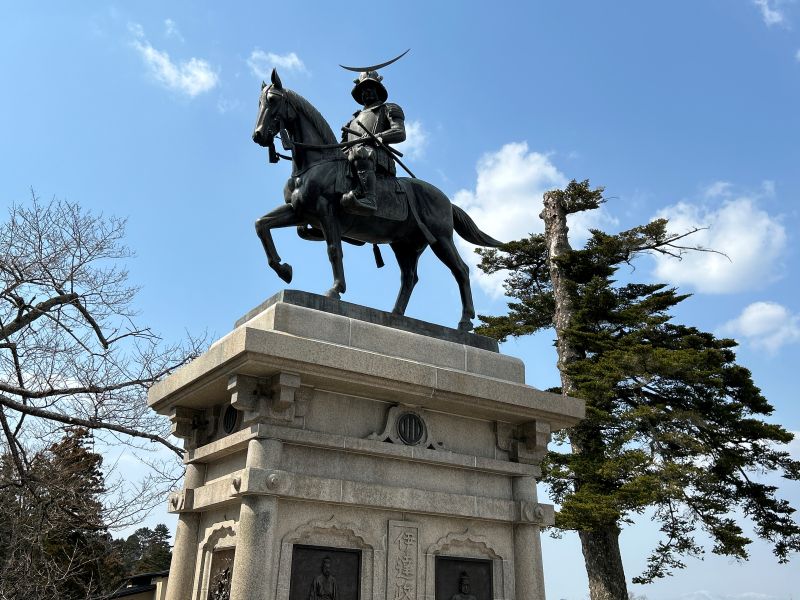
- Category
- Castle ruins (no keep), National Historic Site
- Location
- Sendai, Miyagi Prefecture
- Nearest station
- Sendai Castle Ruins stop on the Loople Sendai loop bus
- From the city
- About 20-25 min by loop bus from JR Sendai Station
- Hours & admission
- Latest information
Overview
Sendai Castle, also called Aoba Castle, was the home of Date Masamune, the "One-Eyed Dragon" and one of the most famous warlords of the Sengoku era. Little of the castle remains, but the site on Mount Aoba, about 115 meters above the city, is one of Sendai's main sights. Visitors come for the stone walls, a reconstructed gate turret, a large statue of Masamune on horseback and the view over the city. Sendai Castle never had a main keep, so what you see is a hilltop site rather than a tower.
History
Date Masamune began the castle around 1601 and made it the base of the Sendai Domain, which the Date family ruled for about 270 years. The castle was damaged repeatedly by earthquakes and fires during the Edo period. After the Meiji Restoration, the army used the site, and many buildings were taken down or lost to fire. Air raids on Sendai in July 1945 destroyed most of what remained, including the Otemon Gate.
In 2003 the ruins were designated a National Historic Site, and in 2006 the castle was chosen as one of the 100 Fine Castles of Japan.
What to See
Walk the surviving stone walls and the earthen walls, and look at the Wakiyagura, a reconstructed side turret of the former Otemon Gate. On the ground of the main enclosure, the outline of the great hall is marked out. The statue of Date Masamune on horseback is the symbol of Sendai, and the terrace around it looks out over the city, and on clear days, toward the Pacific Ocean.
The Aoba Castle Museum (Honmaru Museum), next to the ruins, opened in 1979 and covers the castle and the Date family. It has armor, swords and letters written by Masamune, a large theater that recreates the castle, and a VR guide that shows how the castle looked when it stood.
Nearby, Zuihoden, the mausoleum of Masamune, was rebuilt in 1979 and is decorated in the Momoyama style, and Osaki Hachimangu, founded by Masamune in 1607, is a National Treasure.
Getting There
The easiest way is the Loople Sendai tourist loop bus from the west exit of JR Sendai Station, which takes about 20 to 25 minutes to the stop for the castle ruins. Taxis and other buses also go to the site.
From Tokyo, the Tohoku Shinkansen reaches Sendai in about an hour and a half.
Where to Eat Nearby
Sendai has some of the best-known regional food in Tohoku. Look for:
- Gyutan: grilled beef tongue, served in sets with rice, soup and pickles, the city's signature dish.
- Zunda mochi: rice cakes covered with a sweet paste made from green soybeans.
- Sasa kamaboko: grilled fish paste shaped like a bamboo leaf.
Restaurants open and close often, so use the map links at the bottom of this page to see what is open near the castle today.
Plan Your Visit
Allow about one to two hours, including the museum. The ruins are outdoors and on a hill, so wear comfortable shoes and check the weather. Spring, when the cherry trees bloom on the hill, and autumn foliage are the best seasons, and the statue is lit at night.
Opening hours of the museum change by season, so check the official site before you go.
Staying in the Area
Most visitors stay around Sendai Station or the downtown area, where the loop bus and Shinkansen are close by and the restaurants are plentiful.
FAQ
Is there a castle building to see?
No keep was built, and most buildings are gone, but the stone walls, a reconstructed gate turret and the museum remain.
Is it worth visiting?
Yes, especially for the view, the statue and the story of Date Masamune, and it is easy to reach from the station.
How do I get there from the station?
Take the Loople Sendai loop bus from the west exit of Sendai Station.